


Working Men’s Clubs have been at the centre of Leeds working
life since the 1850s. Nearly two centuries later, the future of these
institutions is uncertain. We meet people for whom “the Club” is
a way of life.
Introduction by Joanthan Turner,
Interviews by Richard Clarkson, Tom Bailey
Pictures by Joanthan Turner
Working Men's Clubs have been a part of working-class history in Britain since the 1850s, and Leeds is home to the oldest one in England: Holbeck WMC. Originally intended as a moral alternative to public houses, the clubs provided recreation, education, and functioned as respectable spaces for working men to congregate.
As a photographer with an interest in people, I’m always curious about the things that bring groups together to make a community. Sometimes it’s faith. Or a sport or hobby. These things draw people together who may, on the face of it, not appear to have much else in common. For as long as I’ve been taking pictures I’ve been drawn to making portraits. And this comes from a fascination with identity. Both how we present ourselves to the outside world, and in how we identify with each other; it’s how we connect with those around us. We form clubs (official ones, or otherwise) with people we have a connection to. And as sociable creatures we need connection with people who are in the same club as us.
In recent years these habits appear to be shifting. Previous cornerstones of communal gathering; churches and pubs, are closing at ever increasing rates. So when the opportunity arose to make portraits in Working Mens Clubs I jumped at the chance. I was curious about the heritage and traditions of such spaces, and also keen to know who goes there; what kinds of activities take place, and whether the sense of community is still alive and well.
According to their national association, three quarters of Working Men's Clubs have closed in the last 50 years. Factors like the smoking ban, and the pandemic have taken their toll, as have changing demographics of former industrial heartlands. Many have dropped the word ‘Men’ from their name in an effort to make them more inclusive spaces, and most now run family friendly events, and opportunities. But they are still very much places for working people, and whilst those that survive may be struggling with dwindling (and often older) memberships, they are still very much community spaces. People know each other. They call in for a drink and a chat. They congregate. And they share common ground; they are ‘in the Club’.
Talking with my portrait subjects, I sense belonging, loyalty, and pride. I sense also how these places meet their need to connect with other people (and in a world of ever-increasing social distance, this connection is a lifeline). They tell me about their own personal histories and connections with the club. They've been coming for years; these spaces have been a constant in their lives. They have made friends, met partners, had parties, brought children and grandchildren through these doors. They have known each other's families, and they remember those members who are no longer with us. The club is more than a mere physical building. It represents community, and is rooted in place.
And in the act of photographing these spaces, both in the portraits I take, and in my attempts to document the atmosphere (the upholstered furniture, the trophies in the glass cabinet, the marked floors that have seen generations of boots and spilled pints) I’m aware that I’m recording a piece of social history. And as traditional pubs continue their slow demise, or metamorphosis into chain restaurants, I hope with all my heart that these small oases of working-class community are still here in another 160 years.



Patrick Mamda, Harehills WMC
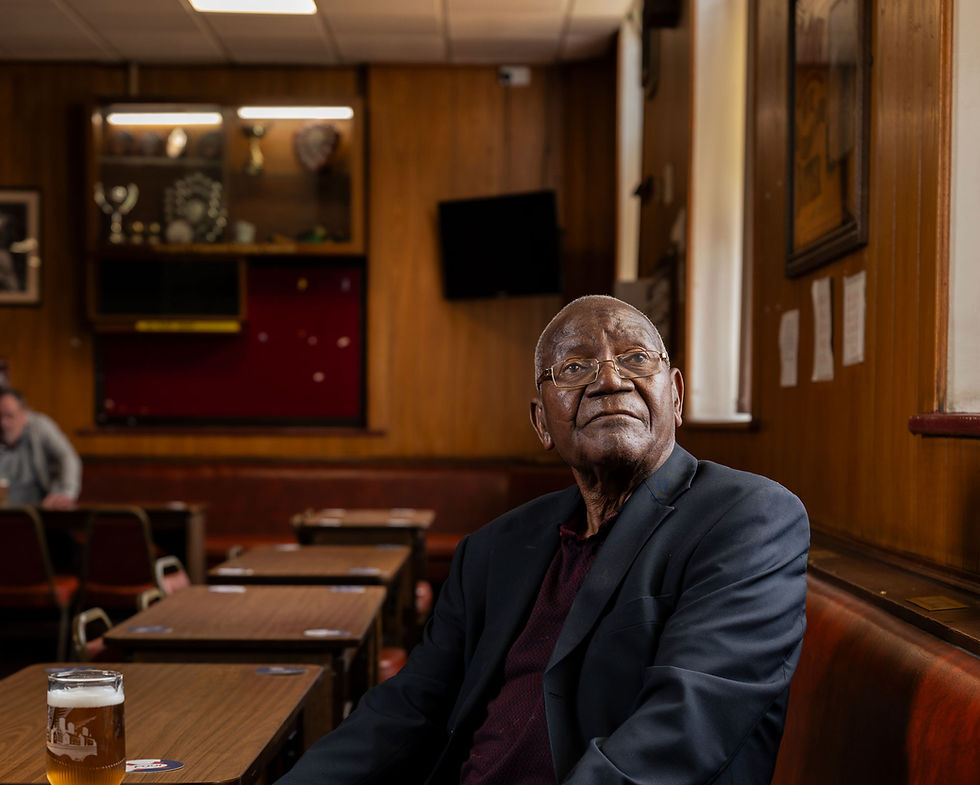

Patrick Mamda,
Harehills WMC


I came to Leeds in 1983 as a student at Leeds University. I came to read for my Doctor of Philosophy in politics. I was born in Zambia. The first time I came to Europe was in 1963. I went to study in Ireland. When I came to Leeds, I did not even know whether I would have a place where to stay. But when I approached my professor, he approached the City Council to get me a place. That's how I ended up in Seacroft. I used to frequent the Seacroft Working Men's Club. That was from 1983 to 1996. I was with my wife and six children. I did not know what Leeds was like and I did not know how I was going to live in Leeds. But I found out that by interacting with people, I got on very, very well indeed. So after my studies at university, I would go to the Seacroft Working Men’s Club and pass my time - because it was near my house anyway.
In those days, there was time for dancing. They would play table tennis, they played bingo, that kind of thing. We enjoyed ourselves there, the whole family. When you come to a place where they've never seen someone who is of my colour - being black - they just wonder how you are going to fit in, into the club. I knew the chairman of the club, and I knew people working for the club. I actually fitted in very easily. There were a couple of people who might say, “Where did this man come from?” But I think with time they got to know me very well, and I got on very well with them.
I was sponsored by the Irish government to work in South Africa, I then decided to move to Zambia, back where I came from, because I felt I owed the people of Zambia. They supported me throughout my life. So I went and worked for Zambia for a number of years, from 2001 to 2023, when I returned to Leeds. I was sponsored by the Irish government to go and work for an NGO in South Africa. This NGO was established to advise unions dealing with farm workers. Their main task was to go into the rural area of South Africa to advise people as to how they should, you know, work on these farms. And if there were any problems, they would come to the farm workers' organisation for advice. My wife is Irish. [I met her a] long time ago. I think it was in 1964. And our firstborn daughter was born in 1965. I'll be 89 next month.


I still lecture. I actually gave a paper recently on what I called “Pa nsaka”.It's an African word. They have a place where elder people in the village meet for discussion and what not, they want to tell stories. The women bring food to eat and sometimes even beer. So that is what the Pa nsaka means. It’s like this Club, it's very similar to this. This is like a Pa nsaka. We are actually meeting to discuss a few things. This will be a European Pa nsaka! It's more or less the same, it's a group getting together. Like us, we'll go to some place and have a meeting, like they have.
You know, many people in their houses, men and women, sometimes they feel lonely. And when you come to a place like this, you can't be lonely anymore. You're able to interact with people. The fact that you have met fellow human beings around and you're able to discuss issues of every kind, you can't be lonely. Because loneliness, I've noticed, leads people to suffer - although I'm not a medical expert - to such diseases as dementia. People want to actually express themselves. That's the only opportunity they have by coming into a place like this. If someone is living on their own and they're not talking to people, then they can get weird ideas that haven't been tried and tested by other people.
During my time in Seacroft, when I was here, I had young men and women going out to play football with me in the football grounds. As a boy I was a good footballer. I was an outstanding young player during my time at secondary school and even at university. II cannot say that I was a star, but in certain areas I was good. In Seacroft we had our own social teams, community teams. In all those fields where there was open space, we used to play games there. I always supported Liverpool FC. Because when Irish people leave Ireland to enter England, they come through Liverpool. But now I support Manchester and Leeds. Leeds first, Manchester second. And we have the Zambian team, of course.
I've lived in Leeds before, and I'm living in Leeds now. I think, you know, one thing I like here is the transportation, it’s very good. And the shops, where to go for this and that, this makes me feel very happy. And the market, we have actually a very good market. I live locally, just near the mosque. [Coming to clubs], I was able to see people of various nationalities. I'm very particular in making sure that I meet people of, you know, different origins. I enjoy that because you learn a lot from people. The beauty of this club is that they are welcoming people. There are people who say, “What can we do for you?” or “Do you need any help?”
This Harehills Working Men’s Club is actually marvellous. It's big, it's spacious. I wish this club was in Zambia, because I would actually be frequenting it if it was in Zambia. It's actually fantastic. People come in here, we share our discussions in various fields: sports, politics. I'm happy being a member of this club. It’s “Pa nsaka”

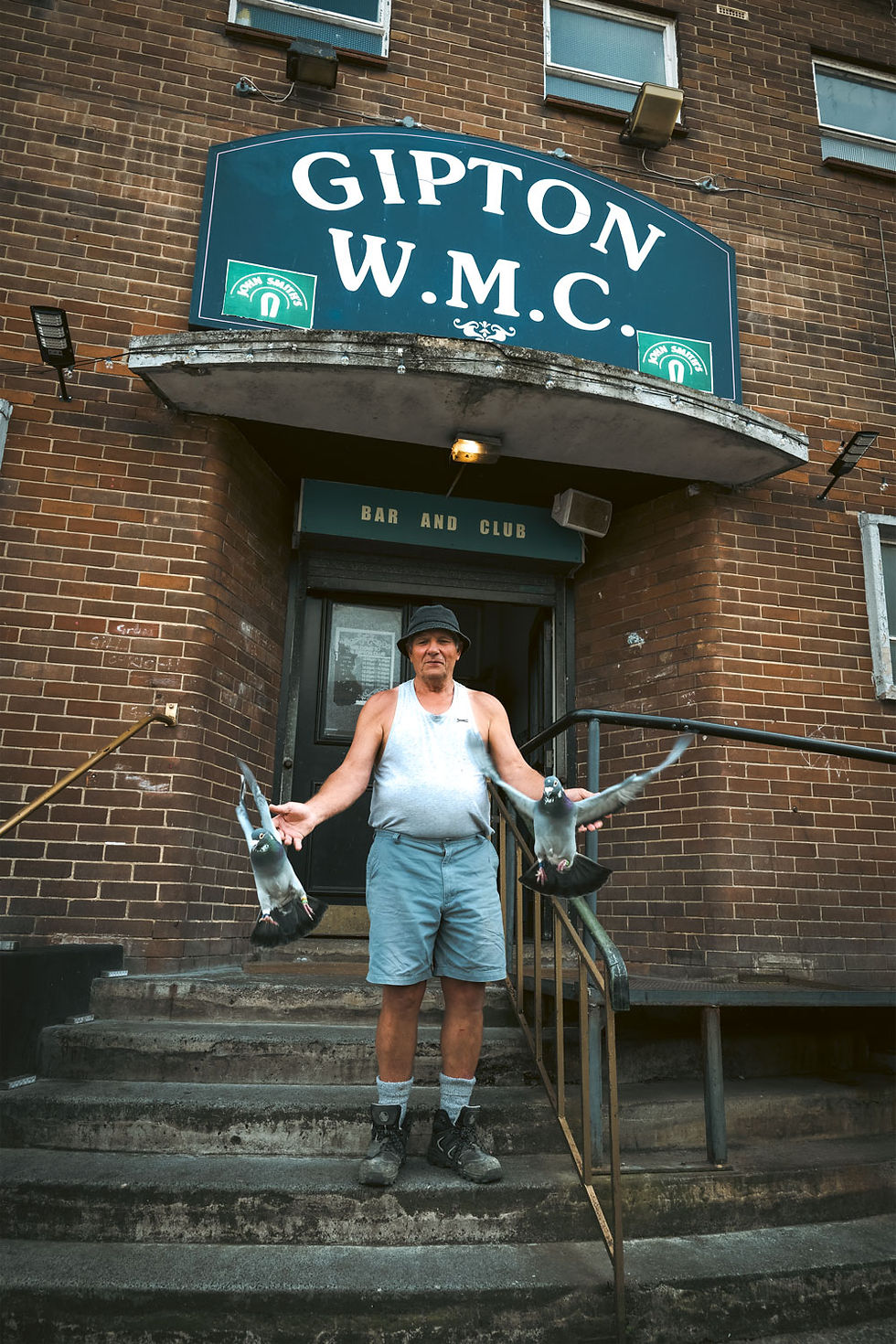
Billy Foley, Gipton WMC


Billy Foley, Gipton WM


Patricia McFaul & Ann Maloney, Belle Isle WMC


Willie and Janet Irish,
Gipton WMC


Steve Marshall & Jim Healey,
Belle Isle WMC


Trevor Duke and Marjorie Lindley,
Belle Isle WMC
I got made a member in 1974. It was absolutely ram-packed. Every room, every day, every night. It was unbelievable. This room that we're sat in now, packed every afternoon. About 1972, I think, I first come in here. I've lived here all my life. Richard Burgon, the MP, his grandad was one of the founding members of this club. Back in the 70s, [a pint was] about one and eleven. On a weekend, you had to queue to get your seat. You had dominoes going, fives and threes, cribbage, darts, snooker. You had everything going. We were in a Monday night league. We've been in it since 1972. And we're still going, we're still running. I first worked here in ‘92. I was here for about three years as a steward. I enjoyed every minute of it. You get a lot of awkward customers. But you still can enjoy it.
We run a Pigeon section from here. You all have your own loft in your own garden. I've been doing it for a lot of years. I've had them since I was a kid and I've had them just in about every house where I've lived. And when I met our lass, I had pigeons then. I started with my brother, who used to be president here at one time. But he's sadly passed on. I stopped for a while, down to work. I didn't have time to look after them. I always had it in my mind that before I retire, I'll start back up with them. Which I did do. Got all organised. I've got a 26-foot-long loft in the back garden. I spend a lot of time in it. We used to have sixty-odd members in [the Pigeon section] and now we've got seven or eight. We just have an AGM each year because nobody can be bothered to come to a little meet. But we're still racing them.
How do we race them? Right, so you've got them there in your back garden, You train them to come home when. Train them, get them fit. And you fetch them here on a Tuesday night. And you basket them. You get about 20 in a basket. In a crate. it's all digital now. You get these little rings, you put them on the legs. And it goes on the machine. That's before they go, so you know what pigeon it is. And when they come home, you have a pad on top of your loft. So once you hit that pad, that clocks them in. And then you just come up to see who's got the quickest one. Quickest pigeon wins. It's not always the first one home. t's all worked out with distances, you know. But your quickest one mainly wins. Wednesday nights, we do Newark, Melton Mowbray. 50 miles, 70-odd miles away. But on a Saturday, they go up France by ferry. When they go abroad, it's a big transporter, you pay that bit extra towards their haulage and petrol. They let them go when the weather's right, yeah. You have a big combine race. That's when they go abroad, big combines. They're well looked after. Winning pigeons, they used to get medals. I've won a few races.
I just found them enjoyable to watch and how they pair up together. When they come home from a race it's just a nice feeling. If you've bred your own pigeons and you see it as a little baby and as a squab, then it's going out after so long, it's flying around and you've trained it up and you've sent it off for its first race and it's come home. It's just nice for that pigeon to come home. I don't give names to any of them, because you lose that many. You don't want to get too close to them I don't think. A lot of people do, they feed ‘em by hand and they have them all over their shoulders and their heads and everything. I just leave mine, I don't get close to them. The only time I handle them is when they're going in the basket for races.
At one time, you had an old clock and it had to be read off. And it took like an hour to do them all, or an hour and a half. So whilst they were doing that, you would be stood downstairs having a pint with lads, talking about the pigeons. You'd have had three or four pints. Now, the lads don't stand there. The digital clocks are done within half an hour. And they've all gone. So there's no money going behind the bar. The chinwag ain't the same. It's partly a social thing. Obviously, you love the pigeons. You love the racing, but it's a social aspect as well. It gets you out. It gets you about. Even if you lose a pigeon, you've got to go pick it up. It's nice to go and meet that other pigeon man who might live down Birmingham or something like that. So you can get about with pigeons.
I call myself a back garden pigeon man. Because it is in the back garden we are with them.
I've still got loads to learn. I listen to lads and their little secrets what they come up with. I take it all in. Cinnamon. You put that on the corn and that gets them at it. It livens them up a bit. They'll try any little thing in the book, will a pigeon man, to get his pigeon home first. We give cider vinegar to pigeons - we put in the water. It kills little mites and bugs. Different types of corn what you feed them on before a race. You want someone with a lot of protein in it. And a lot of people give them little additives when they come home. I'm not bothered about the winning, but if I do, I enjoy it.




Patricia McFaul & Ann Maloney, Belle Isle WMC
Patricia McFaul & Ann Maloney, Belle Isle WMC
Patricia (pictured above): 17 years, I worked behind this bar. I retired last year. I've had my own pubs. I've had four of my own. Believe it or not. I've done over 30-odd years behind the bar My first pub that I took over was Satellite in South Shields. Then I took over New Griffin in Hull. [I was] fair. Because my customers were always right, to me. But I worked in a men's club [before]. My dad used to run one. West Leeds, over on Tong Road. My dad, he was manager behind the bar. Very busy at West Leeds.
I worked up in the Middleton Arms. I did about 10, 15 years. 2007 I got here. [For me it’s the] socialising. I'm not one for sitting, going to work, working in the factory. The 9 – 5. I tried that once, I lasted three weeks. I couldn't do with it. I like [bar work] because you're talking to people.
You get a different class in a pub It's a community isn't it. You'd know people, you know what their order was. As soon as I saw them coming past, by the time they walked in, the mug of beer was on the bar, they didn't even have to ask me. I can also remember rounds, it's a skill. it takes a certain brain to work behind a bar. They're not a bad crowd. I'm not one for carrying on. But you do get the ones that are a bit funny with you. You carry on serving them. You keep a smile on your face. Customer service. You've got to have that old-fashioned customer service, haven't you? That's what I grew up with. It's about just making people feel welcome, isn't it?
Ann: The club at first was over the road and it were a wooden hut. I think that was built 1945, 46 - then it got transferred into this, which were built with brick then. But we had the fire, the big fire in 2000 and it burnt to a crisp. I was on the committee then, one of the first women to come on the committee in 2000. I'm now the president of the club. And I'm doing what I can. I really am. Times have changed now. More women are accepted in here. There's a lot of banter with a lot of men, but women are accepted now. There is a lot of clubs where they can't go in. If you went up north, you'd get a shock. They think women have got two heads up there.
It's had its ups, it's had its downs, like most places. Most of the pubs are going down. And there's nothing you can do about it. If your members don't come in, we can't run the club, because it's the members that keep the bar going. You've got to support the club. I mean, we only pay £10 a year for membership. And out of that £10 you get drinks cheap, you get your entertainment. There's nowhere else to go for that price. We have turns, what you call gigs. We don't open as much as we used to do, because the members don't come in like they used to do. We do a lot of funerals. They do wedding parties, birthday parties. Whatever you want it in here, all that puts money over the bar.


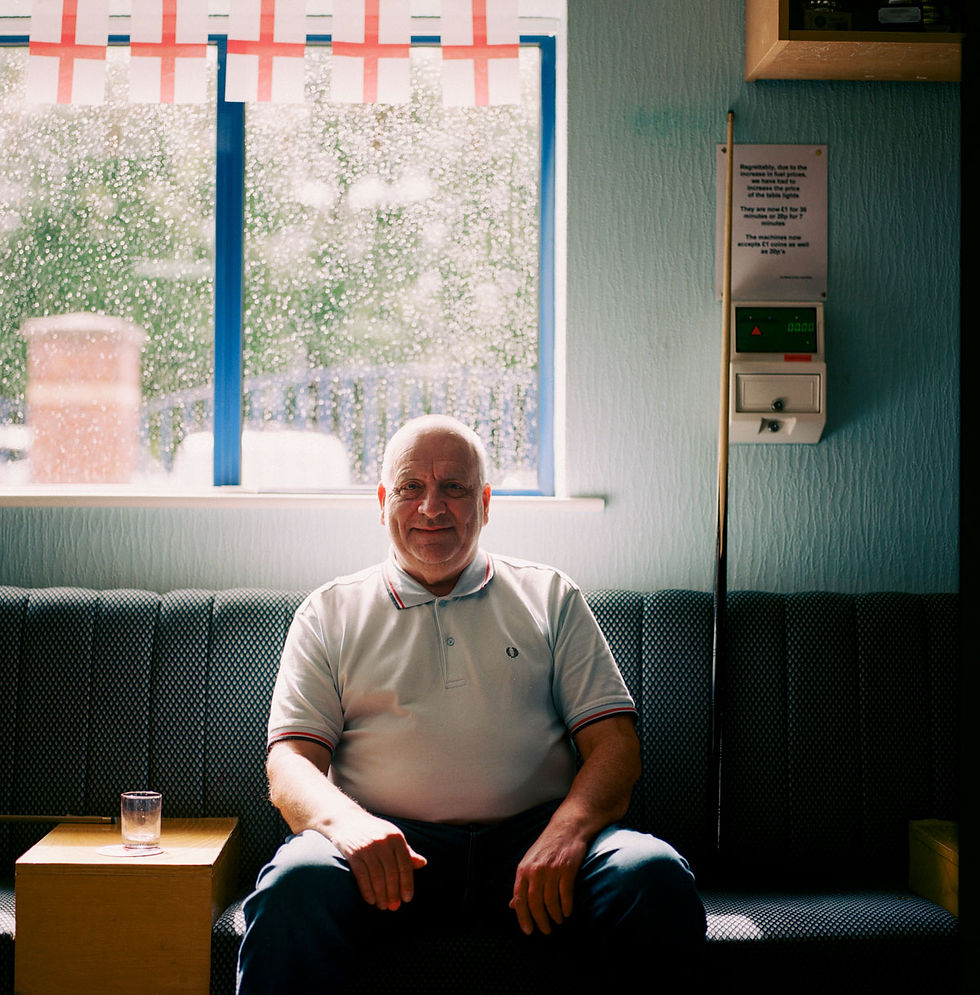
Willie and Janet Irish, Gipton WMC
Willie: I'm from the Caribbean, Montserrat. I came to Leeds in 1957. Landed in Dover, came up to Leeds. I've been in Leeds ever since. They had plenty of work, so we came to this country. My dad come, my brother came and then I came up after. I was 19, I came here to work. I work in engineering. Then I went on to buildings. Leeds were nice. A lot of dancing! From Mecca to Majestic, to Mecca. Dixie Jazz, boppy music. We used to pay sixpence. Go down to Mecca from 12 till 2. Then 2 o'clock, we used to go over to Majestic Ballroom Dancing. And then back to Mecca. On a Saturday, three times on a Saturday, we used to go dancing in town. The days when we were bopping with the king, Elvis, then Bill Haley.
Janet: 1957, I met him. I knew his brother, then he came over. I was at a Christmas party, and then we met, and then we just got together.
Wilie: I met her when she was 17. I remember when we first came here, there wasn't any black girls around. I was 19, she was 17. She was born in 1940, I was born in 1938. I told her mum, and mum accepted me, you know what I mean? No argy-bargy. So we met, and then after we got married - we've been married since 1959 - we moved up here [to Gipton] Sixty-two years in the same house.
I started coming in here in 1964. This Irish lad, he brought me in here. One of the committee men was a bit awkward when I first came in. Just the one incident. Since then, one or two little incidents. You know that's going to happen. But, this Club, we are all friendly. Because in them days, in the 60s, when there was no clubs in Chapeltown, you used to have loads of [black] lads come up here Saturday night. I used to come in there seven nights a week. Dinnertime and night. [The Club is] friendly, you know what I mean? You have to mix with people. I’m the oldest member, I think. I don't think there's many coming here now older than me. I learn a lot in here. You know, mixed with people - and got some tremendous good jobs. Like I say, I'm a building worker. And I pull my weight. Liberal club, they never used to serve blacks. They do now. This was in the old days. I was the first one up here.
Janet: I didn't used to drink a lot. But after the children grew up. I started coming out with him and having drinks. Why not? I used to do upholstery, then I worked in engineering. I worked all over. I was in a factory on Blackman Lane. These days, we go walking, we go up to the cemetery to see my mum's grave. And then sometimes we walk to shops.
Willie: The old days, when you come in here, like a Friday, Irish lads come from work, and it’s full.
Saturdays, you have to queue up at 6 o'clock to get in here. And you don't sit [just anywhere]. “Don't sit there, old Fred’s coming in!” That's a must. Seven nights a week. You know he's going to be here. He'll drink a pint from 8 till half past 8. Four pints a night. And then he's off. That is the regularity here. That's the routine. I mean, you have your game of dominoes, and you know everybody, your team. We had a table upstairs, nobody used to sit on that table. I was working two to ten. The club shut at ten o'clock, and I used to come in here, two, three minutes to ten, and I’d have five pints. I'll order them all at once and get a tray. Everybody's coming up for their last pint, you’d order five or six.
Janet: We have five children, eight grandchildren, twelve great-grandchildren. You have to pull together.
Willie: It’s about teamwork. We do everything together. Nobody has no special duty, we have to cook, I get up this morning, did all the cleaning and the washing. Next year we'll be together 70 years. Sitting in the room here, we got memories, we got good memories You know, they were shutting it down. They came in here to close it down. They closed Seacroft [WMC]. Most of this furniture here come from Seacroft. Then Mary took over Gipton. Mary has improved it. A hundred and fifty percent. Mary does a lot for this club. Especially for children. There's lots of kids parties. And funerals and birthdays and things. That's what keeps it going. Bingo. We have a bingo on a Saturday night.


Steve Marshall & Jim Healey, Belle Isle WMC
Steve (pictured above): I was born in 61. I’ve always come in here from being 15 or 16 - a junior member - and I played snooker. I've lived in the same street as we were born in. I was born at No. 6 and I live at 36. This Club, it’s my life and my heart. And I could fill up thinking about it. But everything's altered. Back then, there were the Middleton Arms, the Omnibus, Grey Goose and Belle Isle Pub. Them pubs were full every afternoon with people that had done graft. I was a mechanical engineer. Hunslet was quite heavily populated with engineering people. This Club was full. It was full of God's honest, truthful people. Because anybody that got on the committee knew that they were good people. It taught people the trade. You can see the steady progression of people who worked behind the bar, that started off glass collecting, and then they slowly expanded into steward.
The Club lost a lot of money. I was president, probably about 2017, before COVID. I were quite good. I’m not blowing my own trumpet. But within three year, we broke even. But that wasn't me. That was other people as well that were sorting it. This is us. This is our...home. Born and bred, same street. It’s in here. We've gone through a couple of changes. I packed him because my wife got breast cancer. So I had to shift it sideways. I couldn't work. I passed it on.
The fire. I was on my way to Ireland fishing. The road were closed. Ray Crook, Walt Morley, stood on tram-tracks outside here, on Green, and they were hugging one another. It was their life. They'd been in this club all their life. And it was just... it was a mangled wreck. A complete and utter mangled wreck. My dad died in 2001. So we couldn't have funeral here. So we had it up at the Omnibus. There's loads of stories. Millions of stories, here.
Jim: I met my wife in 1972, and she was a member here. That's how I came across here. I was a member across the other side of Leeds at Swarcliffe, and transferred my membership. I got made a member here in 73. I got married in 74. I got on the committee in 81 as a trustee. And I've been on since - so 45 years.
I was working at the time [of the fire] driving a taxi. My son rung me. And said, “Dad, the Club's on fire!” I said, “What are you talking about?” So I came up here. There were fire engines all over. But it were completely gutted, apart from a small corner. The foyer was completely gutted. Games room, lounge, concert room, gone. One of the main reasons it burnt down so well was the remains of the wooden huts were still in the false ceiling. It was still the wooden roof, they’d built over it. And that's why it took hold so quickly. Couldn't be saved. After, we all moved. The Labour Club down the road, they accepted all our members temporarily to go in there. Our secretary at the time, he was the Clerk of Works on site, making sure that the club was rebuilt to the specifications. It took some doing.




Trevor Duke and Marjorie Lindley, Belle Isle WMC
Trevor: I used to come in here when it was a wooden hut. And I carried the bucket and sponge with my oldest brother, who was captain of the football team when he was 15. The football team were here a lot. He stopped playing for 12 months because he had his arm off when he was 16. An accident at the Leather Tannery, where he worked. I've come in all them years - I've been a member 60 years. It's the club, it's the company. It's all the good people that come in that I've known for a long time.
I worked down pits all my life. I was at Lofthouse, where one of the disasters was. Then I went out to Selby. When I started at Lofthouse, it was two-foot seams. At that time we used to always call at clubs and pubs going home. Miners, they put a lot into clubs and pubs down here. Because it was only a few hundred yards from over at Middleton Broom. They all shut, and they come to Lofthouse. And then when Lofthouse shut, a lot went to Selby. When I started, you had to have your own transport. And then they put the buses on. As things went on, and they were shutting a lot of pits out there, they knocked all the buses off. I used to cycle to Lofthouse. I mean, I were fit then. It was 14 miles a day. Rain, snow, whatever, I just carried on.
Leeds was a very big industrial estate. Leadworks. Mines. A lot of factories. John Fowler’s with trains. We had the oldest railway. At the side of the pit, it was a little village. Belle Isle village - I used to knock about with some lads when I first started school. it's all been pulled down since. But in them days, we did everything there. The old village, the pit, the railway. What more history did we want? We got the lot!
You can’t beat a drink. Round here, you had your Grey Goose. Lower down, you had your Belle Isle. You had the other club in the estate. You had the Omnibus. All them's closed. I've always liked the Belle Isle Club. I always will, won't I? You can’t beat a drink. I've always been a club man. I like clubs. It's a nice atmosphere. This is where I met my good lady in here.
Marjorie: I’d been coming in a couple of years before I met him. I used to sit down near the front with some friends. And a couple of times they didn't turn up, so I just sat there on my own. So, at the back, what they call the garage - they call it the garage because it's a lower ceiling – and somebody I know said, “Come down and sit here.” Sat here was her and her husband, another lady and Trevor. We just chatted away like you do. And I thought, “God, he can talk, he never stops talking to me.” I did that for quite a long while.
Ann and Trevor started sharing taxis home from the Club.
And then it comes to after Christmas. And we had a Christmas party on for pensioners. I'm sat this side of the concert room, and he's sat over near the window. He said, “I'm sat with my sister and her husband. Come over and get a lift home.” So I went over. His sister started talking to me. I thought, God, she talks more than Trevor. And she said, “I'm glad you're going out with our Trevor. You’re a lovely lady.” I said, “No! I'm not going out with him!” I thought, Shut up. I don't want another fella…
Trevor: We've been together ever since.
Thanks to the staff, committees and customers at Belle Isle Working Mens’ Club, Gipton Working Men’s Club and Harehills Working Men's Club.