


Hear the stories of three generations of Black musicians who helped shape Leeds’ music scene, from the jazz clubs of the 1940s to the reggae and hip-hop sounds that followed.
Introductions by Tom Bailey
Pictures by Joanthan Turner
As Lanre Bakare writes in his book We Were There, “no European country has been changed by Black culture more than the UK.” Bakare explains how cities across the UK were radically changed by the influence of Black British artists, musicians and activists – and Leeds is no exception. Our city has a long history of Black musicians carving their own path and creating new cultural movements. We wanted to shine a light on this phenomenon, through the stories of three Black British musical artists from three different generations.
Firstly, Bob Barclay. Bob ran the Studio 20 jazz club in Leeds city centre, finding great success with the Yorkshire Jazz Band in the 1940s and 50s. Bob’s story was largely forgotten until members of his family decided to research his history. Bobs son Simon and grandson Cyrus share what they know of this iconoclastic musician and entrepreneur. Skipping forward a couple of decades we meet Reginald Challenger, who played drums for The Bedrocks in the 1960s. Hailed as “the first Black British group in the Charts” they had a huge hit with a reggae-infused cover of Ob-La-Di, Ob-La-Da. Finally we meet Jovanni Sterling (AKA Graft), a hip-hop artist who was inspired by the Black musicians he grew up with in Chapeltown. Graft speaks of his debt to the older generations who taught him “how to be successful by not folding or trying to bend to what people may want from you”.


Bob Barclay was a Black tuba-player and club owner who lived in Leeds in the mid-twentieth century. As leader of the Yorkshire Jazz Band, he played all over the country and counted Louis Armsstrong and Ella Fitzgerald as friends. However, his musical career was little known to his family. Some years ago, the Barclays began researching Bob’s story; and they were kind enough to share what they uncovered with us.
Simon: I never met my grandparents. My dad and my mum separated when I was a little boy, probably about two or three. And then I only ever saw him maybe, I don't know, maybe four times in my whole life.
Cyrus: [Bob] passed away long before I was born. He had a stroke in the 1980s. For years in our family, it was kind of a mystery. He wasn't really talked about. He wasn't around for my dad or his sister, so they didn't really know him. His ex-wife (my dad's mother) wouldn't really talk about him much. My aunt (Dad's older sister) went on a genealogical journey to try and sort of trace our roots, because we never knew where we came from.
Simon: We've gone back as far as we can. [We found] my great-great-grandad on a ship’s manifest. Coming from Guyana to Scotland. So he came on a boat to work on the rope industry, presumably as a slave. Early 1800s, they came over. Then slavery was abolished
Cyrus: So our surname is Barclay, because that was the name of the plantation. That’s three generations above my granddad. I know that [Bob] was born in Scotland.
Simon: Then they made it from Scotland to Liverpool. My dad spent quite a bit of time in colliery bands.
Cyrus: [Bob] ends up in Leeds playing, I believe, the bugle in the military band was when he started. There's an anecdote [that] the reason he ended up playing the tuba - and being called King Tuba was because he was told the bugle was too noisy. So he switched to the tuba. We found out probably about six months ago that we have a whole secret family in Canada that we didn't know about, from his first marriage. He came to Leeds as a truck driver in the military during the Second World War, I believe. Records are very shaky. And he met my grandmother at the same time, which is a really lovely romantic story. She was working as a wet nurse in a stately home. He left the army and was a chauffeur for the same family. And that's how they met. She was a widow when she met my granddad. She lost her husband in the war. She had a son from that marriage who got pulled out of private school, unfortunately, when she married Bob. I think that was a very difficult childhood for him as a result because he suddenly had a black stepfather in the 1940s.

“ALMOST EVERYONE YOU COULD THINK OF FROM THE 1940S TO 50S JAZZ SCENE AT SOME POINT PLAYED [AT STUDIO 20]. BEFORE THE BEATLES WERE FAMOUS, [THEY] OPENED FOR THE YORKSHIRE JAZZ BAND.”

Bob Barclay was a Black tuba-player and club owner who lived in Leeds in the mid-twentieth century. As leader of the Yorkshire Jazz Band, he played all over the country and counted Louis Armsstrong and Ella Fitzgerald as friends. However, his musical career was little known to his family. Some years ago, the Barclays began researching Bob’s story; and they were kind enough to share what they uncovered with us.
Simon: I never met my grandparents. My dad and my mum separated when I was a little boy, probably about two or three. And then I only ever saw him maybe, I don't know, maybe four times in my whole life.
Cyrus: [Bob] passed away long before I was born. He had a stroke in the 1980s. For years in our family, it was kind of a mystery. He wasn't really talked about. He wasn't around for my dad or his sister, so they didn't really know him. His ex-wife (my dad's mother) wouldn't really talk about him much. My aunt (Dad's older sister) went on a genealogical journey to try and sort of trace our roots, because we never knew where we came from.
Simon: We've gone back as far as we can. [We found] my great-great-grandad on a ship’s manifest. Coming from Guyana to Scotland. So he came on a boat to work on the rope industry, presumably as a slave. Early 1800s, they came over. Then slavery was abolished
Cyrus: So our surname is Barclay, because that was the name of the plantation. That’s three generations above my granddad. I know that [Bob] was born in Scotland.
Simon: Then they made it from Scotland to Liverpool. My dad spent quite a bit of time in colliery bands.
Cyrus: [Bob] ends up in Leeds playing, I believe, the bugle in the military band was when he started. There's an anecdote [that] the reason he ended up playing the tuba - and being called King Tuba was because he was told the bugle was too noisy. So he switched to the tuba. We found out probably about six months ago that we have a whole secret family in Canada that we didn't know about, from his first marriage. He came to Leeds as a truck driver in the military during the Second World War, I believe. Records are very shaky. And he met my grandmother at the same time, which is a really lovely romantic story. She was working as a wet nurse in a stately home. He left the army and was a chauffeur for the same family. And that's how they met. She was a widow when she met my granddad. She lost her husband in the war. She had a son from that marriage who got pulled out of private school, unfortunately, when she married Bob. I think that was a very difficult childhood for him as a result because he suddenly had a black stepfather in the 1940s.
Cyrus: He was probably in his 30s when he set up the jazz club.

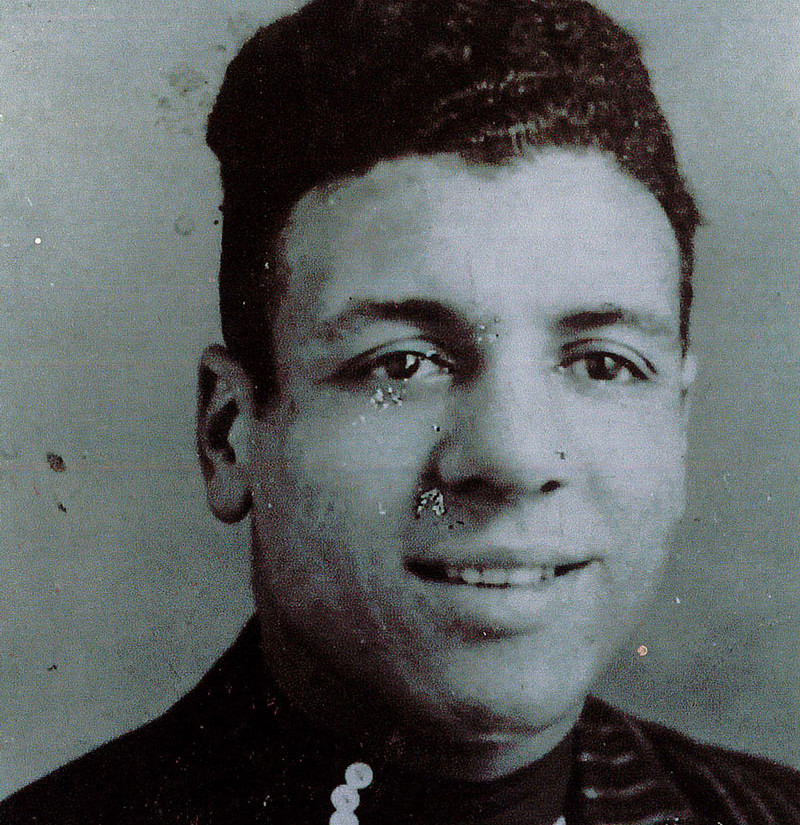
“ALMOST EVERYONE YOU COULD THINK OF FROM THE 1940S TO 50S JAZZ SCENE AT SOME POINT PLAYED [AT STUDIO 20]. BEFORE THE BEATLES WERE FAMOUS, [THEY] OPENED FOR THE YORKSHIRE JAZZ BAND.”
Simon: My mum and dad owned the club. And he was serving, chicken in a basket and things. They also owned, not an Airbnb, but a hostel-type affair. They had lots of people come and stay there, mostly jazz musicians.
Cyrus: It was very much a hole-in-the-wall kind of club that was very underground and very illegal. He got in trouble with the police a lot. [There was] a beautiful piece of wallpaper in that club where he'd get all the musicians to sign it. So I think Ella Fitzgerald, Louis Armstrong, all these. And they tore it down without knowing. [The Club] was very, very small. I know that for a fact. It had one small kitchen, but all it did was serve chicken and chips. It wasn't allowed to serve alcohol. He did still serve alcohol. And he sold cigars from there as well, which got in trouble with the cops a lot.
Simon: I think my mum mainly stayed at home, and my dad was a bit of a gallivant.
Cyrus: [Bob’s wife] Iris was very prim and proper and posh. I'm always really amazed that she worked at an underground jazz club. She wore gloves and a hat, perfume and pearls; and very well-spoken Queen's English. [He was] a bit of a womaniser. The ladies loved him. There are so many pictures of him I pulled out where he's just surrounded by young women. But when my grandparents were still married, my nan worked in the kitchen, he worked on stage. And they used to have this amazing vinyl recording system where they just flipped the record over. So there were thousands and thousands of recordings of these bands that played there.
Cyrus: The Yorkshire Jazz Band. They were 15-piece jazz band.
The celebrated Yorkshire Jazz Band was a mainly white band, with Bob as the only Black member. The band, established by two students at Leeds College of Art, developed a national reputation and toured extensivley.
Cyrus: He was the manager for the band as well. All the band members were between 18 and 25 and he was in his 50s. He used to have real trouble with booking gigs. So he would get some of the younger band members to go and book the gigs - because they were all white. It was a lot easier to send a young white man to go and book the gig - they'd be more likely to secure it. They became really big in Poland. They toured in Poland for a while. [The band] went down particularly well in Poland. He left [the band] to focus more on the club, and it was around the same time he formed a really close friendship with Louis Armstrong. One of my favourite personal brags, was that my grandad was very good friends with Louis Armstrong! He came to play at the club, I think, six times in his lifetime. Louis Armstrong really liked the fact that my grandad sold very cheap cigars. He was very keen on the cheap alcohol and cheap cigars. And Ella Fitzgerald. Almost everyone you could think of from the 1940s to 50s jazz scene at some point played there. Before the Beatles were famous, [they] opened for the Yorkshire Jazz Band.

Add paragraph text. Click “Edit Text” to update the font, size and more. To change and reuse text themes, go to Site Styles.
Simon: My dad lost the club through selling contraband. He was buying cigars and alcohol from the American troops and then selling them behind the bar, which was supposed to be a speakeasy, so no alcohol.
Cyrus: He was always touring. He just wasn't really present in my aunt and my dad's lives at all, because he was either always touring or always in the club. Outside of jazz, he didn't have another job. As he got older, he divorced my grandmother.
Simon: He had a couple of strokes towards the end.
Cyrus: He was left incapable of playing music. He was essentially bedridden for the last 10 years of his life.
Simon: Then he had most of his music stolen. Someone pretending to be from NME [New Musical Enterprises] went round and took all the [records] away, ready to correlate or whatever - and just never turned up again. That was a weird one.
Cyrus: They took his, all of his recordings from the studio of all the bands that ever played there [and] never returned them. We lost thousands of hours of really rare jazz records. It's such a shame, because that would be a fantastic piece of archive. I think after that point, he was very cut off. He sort of sealed himself off from people who wanted to talk to him about his jazz. He was a very reclusive person from that point on. He never talked about his past, never really talked about his childhood, never shared anything like that. I think after he sort of got screwed over and lost all of those records, he really shut off.
Cyrus: Not a single member of our family knew about all this until we started researching it. There's so many gaps that we just will never know, because unfortunately, so many people have now passed on.
Simon: I was born in Leeds, 1963. My dad gave me a record years and years ago. It's the first pressing, the first album that they ever produced. And it was Big Chief Battle Axe, which is like their signature tune. [Finding out more about Bob] started off because I knew my dad was a jazz musician and I been in touch with people like Terry Cryer. He used to play with [the band] many years ago. He was travelling with my dad back from London, he was drunk. He had a car crash and Terry Cryer ended up injured, so he couldn't play again. So he took photography. He's got some amazing photographs from inside the club.
Cyrus: I think setting up the jazz club was a way of sort of positioning himself where he could achieve things. I don't think he could have achieved something if he hadn't set that up. He would have stayed just being a truck driver for the rest of his life. I think that was a way of putting himself in a position of power that he wanted to be in and avoid the discrimination.
Cyrus: I feel very proud. The discrimination he faced and how he essentially built the Leeds jazz scene. He's one of the original Leeds jazz musicians. I feel really empowered to go and be driven in my own right when I think about where I've come from. You can build yourself up from nothing. If he hadn't started the jazz club, he would have just been another lorry driver in Leeds. He could have never made anything of himself. He made a solid income as a jazz musician. The performing arts thing really runs in our family. It's definitely genetic.


I was born in St. Kitts, but I grew up in Nevis. I came to Birmingham to my dad in 1962. My dad brought me over. He used to work at Fort Dunlop in Birmingham. I was 14. When I came, I knew I had family in Leeds, but I hadn't seen them since they came to England. I found out my brother, my eldest brother was here. My auntie, my mother's sister was here. And cousins. So I felt more at home here than I did at Birmingham.
[in the UK it was] totally different. Because back home, you had to get up early in the morning and do what you had to do before you went to school. [In St Kitts] I was in the country - I'm a country boy. You had to go look after your animals. We didn't have water in our house. You had to go to the water dam and carry buckets and fill up the tank before you went to school. We all had chores. Some would have to sweep the yard. Even though you did all that, you still couldn't get to school late. You had inspection. Make sure your nails are clean, your teeth are clean, your hair is combed. It was a different way of life.
I started music since back home. As a young kid, we used to make our own instruments. We’d make guitars. [We’d get a] sardine tin, then you get a piece of bamboo, and you push it through, then we get the fishing wire and those were our strings. And a big bottle was the bass. Just any sound, just to make a sound. The older guys used to play [in] the steel band. As kids, we used to watch them.
I only came to Leeds when I left school. Back in the 60s, there wasn't a lot of us. When you walk, you used to look to see if you see a black face. It doesn't matter where you came from. Whether Jamaican, Trinidad, it didn't matter. As long as you're Black, you can identify with somebody. I used to work at a tailor's place up in York Road. The guys marked them out, and I used to cut out the suits. I had all kinds of jobs. When I got to 18, I joined the TA. I got to travel. That's where I got my HGV driving license. We used to go all over.
I loved music. I didn't have drums, but I learned, just watching somebody play. Sometimes you put a record on and you listen to the drummer and you practice, you practice. How I joined the Bedrocks, it was pure accident. They had this English guy called Rick. He was a very good drummer. He used to teach me. And he had an accident. The Bedrocks had a gig in Bradford and they needed a drummer. So they said, “Come on, you're always around.” Because I knew the guys. They formed back in ‘64. Back then, it was the Bedrocks Sunshine Band. Then it was Lou Prince and the Bedrocks. Then we became the Bedrocks. Everybody in the band did their bit [of singing]. We used to practice up on Avenue Crescent, down in the cellar.
“EVERYWHERE WE WENT, PEOPLE USED TO JOIN IN. IT GOT REALLY FAMOUS. WE GOT INTO THE CHARTS. IT WAS ON THE RADIO. WE WERE THE FIRST
BLACK BAND EVER TO GET INTO THE BRITISH CHARTS. ALL BLACK.”

Add paragraph text. Click “Edit Text” to update the font, size and more. To change and reuse text themes, go to Site Styles.

I can’t even remember my first gig. It might have been the Mucky Duck – or the White Swan - down in the Calls. We played so many different gigs. We played at the Mecca, The Spinning Disc. Back then, you had a lot of artists. The Equals come there. You had Joe Cocker. Because [the Bedrocks] were local, we were there all the time. Barnsley Town Hall. We played all over. We played all over Scotland, Kilmarnock and all them places. Wales, all over the country. We earned a living! I quit at the tailor’s. One of the best gigs, where we used to love to play was Barnsley Town Hall. The crowd was brilliant and it was always full. They never had anywhere else to go. They saved up, and they were looking forward to that one gig.
We wasn't a reggae band as such, we were more like a soul band because that's the music we used to listen to. Otis Redding, Wilson Pickett, Sam and Dave. All that good stuff, that’s the music that we used to play. Just covers of other people's songs. We never wrote anything. You see, we were the only Black band. We were the first Black band ever to get into the British charts. All Black. You had the Equals, [and others] they were all mixed.
We did a cover of Ob-La-Di Ob-La-Da. And with it being like an African song: “Ob-La-Di Ob-La-Da, life goes on, brah.” Brah, which is how we say “brother:. We were playing, I can't remember exactly where, somewhere in London. Somebody heard us - we didn’t know who was who and what was what - but the Beatles heard us, heard the band. And they wanted us to record it. They loved it. Paul McCartney and them, they all came in while we were recording it. Up at EMI studios in London. They had a place up the road. They watched us doing our thing. They were just ordinary guys.
Everywhere we went, after we started playing, people used to join in, you know, so it got really famous. And then we got into the charts. It was on the radio. Back then you didn't have a lot of TV. When they advertised it “the Bedrocks are coming” – you wouldn’t believe it. We'd go up to Scotland - all white audience most of the places we go. No blacks. We’d go down to Wales, you know, same thing, go over to Barnsley. We got to number 2 in Japan! We went on Top of the Pops, and then we went on Colour Me Pop on BBC2, Maynard Ferguson, he had his own show, we went on that. We went to Germany, to Belgium and Egypt. They may not be able to speak proper English, but when they hear the song, because when you play it, they all join in.
Back in the day, I used to be frightened to go into town. The girls used to chase me. People used to come and sit, because they could dance to us, and they could join in with us. When you went to places and people take out their cameras.
Otis Redding. I played with him. Otis Redding, Wilson Pickett, Arthur Conley, Percy Sledge, all them. It was called the Stax Soul Show. We were on the bill. You can identify with them. Because you knew their songs, we used to play their songs. They’d just come down and say, “How you doing? They’d talk to you. The funny thing was, they all knew of our song.

Add paragraph text. Click “Edit Text” to update the font, size and more. To change and reuse text themes, go to Site Styles.
I used to work on the doors at the International. The owner was called Lee Hyman. It was the Glass Bucket, that was what he was called first. Then it became the International. It was the only place where you could go and see Black performers. Back in the 60s, there was Blacks in Huddersfield, Bradford, Sheffield and all, but they didn't have anywhere to go – so they all came to Leeds. We had Jimi Hendrix there, we had all them guys from Jamaica, all them reggae stars. We had Bob Marley, we had Toots and the Maytalls. You name them, we've had them. All the gigs – for nowt! Hendrix, he was a big star, he'd done Purple Haze by then. You’d meet all those guys, and people [would be] screaming and shouting. You’d think to yourself, “what are they screaming and shouting about?” Even Winston Groovy came. When he walked into the Club, this man said “Challenger, what are you doing here?” We're at the school together in Birmingham!
We did a few years [in the band]. I actually got married and I had children and I decided, “Right. It's time to buckle down and get a proper job.” I used to work at a place on Dewsbury Road called Leeds Metal Spinning Company. Back in the day, you needed a job and you just walk around, knock on doors and get a job. There was a job advertised in the paper – “salesman”. At Dixon’s. So I applied and I got the interview. [The area manager] said to me, “When can you start?” I said, “I can start on Monday!” Every year, I used to win the top sales award. I was in charge of the hi-fi department. I worked there from 1974 until I retired, 41 years. I enjoyed it, because you don't meet the same people. When you work in a factory, same people day in, day out. In a shop, it’s new people. Different people every day.
I still play. Sometimes the steel band, they'd be short of a drummer. It's just a gig. “We’ll call Reg!” It doesn't affect my work, Because it's on a night. I used to get paid. They could always call on me. As long as they had a drum kit, no problem. You know, I've been to places where I didn't know existed. It was an experience for me. I've met so many different people in life. You could tell the genuine ones. I’ve been in England like nearly 60 years. I’ve got grandchildren – and they've got children of their own. Yeah, it's great grandkids. I’ve got so many Challengers now – and they’re all mine!


Growing up, I was always around music. My mum, she was a singer. She used to sing on lovers' rock records. My uncle, Wayne, he was a hip-hop producer. And then my uncle, Roger, he was in a band. So back in the day, they used to have sound clashes. There'd be people from each area, they'd get together, they'd bring their own speakers, own cassettes, vinyls, and they'd have a clash against one another. To see who played the best songs. [It was] a positive experience of sharing music.
[At] 13, 14, I started to delve into writing poetry. I used to play a lot of sport - I was playing for Bradford at the time, so the demands of football were really high. But music and poetry was a way I just used to express myself. I then delved into writing more hip-hop music. It progressed from poetry to then writing freestyles and songs. I just used to keep it to myself. My friend at the time, Yefi, he had this inkling that I was writing songs. He just knew, but I didn't know how. He just used to be like, “I want to hear what you've been writing.” After a couple of years of just keeping it to myself, I showed him a song that I wrote. It just blew [his] mind. He couldn't believe how good it was. From that moment, I just continued writing, just progressed from there. It led me to film a freestyle, it was in 2015 - that went viral online. From that one moment, I thought, “I enjoy this. I'm pretty good at it.”
I was 15. I felt cool. I'd go to school and everyone knew about the freestyle. But it was also a surprise to many people because they just knew me as a footballer. When I was thinking about how I want people to address me as a musician, I was thinking of a name that resonates with me and something that was true to me. And hard work and grafting is something that I feel like I embody. So when it came to choosing an artist name, I thought: Graft. I was inspired by my mum. Because from a very young age, I've seen her graft. Seeing her work extremely hard, I think that's a trait that's been passed on to me.
I got signed at Leeds United when I was 16. In the academy, a two-year scholarship. At that time I was releasing my first couple of freestyles. But my focus was just football. Music was just a hobby. It helped me to alleviate a lot of the stress that football brought. Very intense. Especially at that age, coming out of high school. So my focus from 14 to about 19 was all football. But at the same time, I was releasing music, and music was going well. I moved from Leeds to Rotherham, when I was about 18. But when it came to actual decision, they didn't offer me a pro-contract. [It was] heartbreaking, frustrating. For so long, I've dedicated all this time to football, but it didn't materialise. What if I put more energy into music? What's the worst that could happen? At 20, I put all my effort into music.
“GROWING UP IN CHAPELTOWN, YOU'RE AROUND SO MANY TALENTED PEOPLE, FROM MUSICIANS, ATHLETES, ACADEMICS, CREATIVES, ENTREPRENEURS. BEING AROUND THAT, I THINK IT GAVE ME EXAMPLE, THE INSPIRATION TO TRY AND FIND MY PATH.”
The Rap Game came along about a year or two after - A TV show. I remember at the time they contacted, I used to think, “I don't want to go on TV.” I was just not responding. But they kept persevering, so I sent one of the messages to my friend. I was like, “What do you think of this? Should I go on this?” They were like, “Bro, if you go on, you're going to win!” Within a couple of weeks, I was on the show. We all stayed in a penthouse in Birmingham, six of us contestants. Interesting dynamic. But being on that show completely changed my life in every way you can think of. The exposure, the monetary gain, the opportunities, the collaborations, the sponsorships. That show allowed me to do music full-time. I was very grateful for that. I learned a lot about myself as well. You had to write a song in less than 24 hours and then perform it. With that and the pressure of all the cameras, the whole opportunity was getting to me early on. Then I calmed myself down, composed myself and got all my lyrics out - and I went on to win the show. A few of the highlights from after winning the show was performing at Reading and Leeds Festival, performing at Black Music Festival. performing across the UK, London, Manchester, Leeds. Having my own headline show in Leeds. That was incredible.
I took a break from music about two years ago, just due to the fact that I was doing so much. It was very fast. I was enjoying it but I was wearing so many hats that it wasn't allowing me to just be an artist. I had to be a manager, producer, videographer, creative director, planner, everything. The ownership fell all on me. I just got to a point where I was like, I need to take a break from this. So two years ago, that inspired me to set up my own outdoor company: Come Outside. I think a big part of where that comes from is the way that I've been brought up. To look after people, to respect people, to treat people as I'd like to be treated. A big quality of mine is motivating people. I always want to see people do well. I support as many people as I can. And now Come Outside is ending. I've had more of the space to think creatively. I've been writing again. I'm just looking forward to this next chapter in my life. I need to focus on me.
I think growing up in Chapeltown, you're around so many talented people, from musicians, athletes, academics, creatives, entrepreneurs, there's so much going on. And for me, what resonated with me at that time of course was sport and music. Being around that, I think it gave me an example, or the inspiration to try and find my path. You've got carnival, you've got people from different parts of the world that are all living in one area. So I was exposed to different cultures, languages, music, ideas, all in one melting pot. I had a good foundation.
Reggie Challenger - what a great guy. My uncle Wayne and Reggie, they're very close friends. When I was growing up, Reggie used to come over, we'd go on bike rides together. Reggie'd be at my uncle's house and for barbecues, they'd be playing all the music that they were into, whether that was hip-hop, soulful house, reggae, soul. I'd just be around them vibing, dancing, having fun. And Reggie's got such a bright and unique personality. There's no one like Reggie.
I think there needs to be more money implemented to create a better infrastructure for the next set of artists coming through, because there is that for particular genres and demographics in Leeds, but for singers in R&B or soul and rap and hip-hop, that's behind. With my journey in music so far, I've been able to set an example of how to be yourself, how to chase your dreams, and how to be successful by not folding or trying to bend to what people may want from you or what the industry is promoting, but just by being authentically yourself, there is a way, and you can be successful by being you.