A LEEDS LIFE
THE SAME
SQUARE MILE
Rita Green
b. 1928
Rita Green was born in Bramham, where her mother worked in service. When Rita was three, the family moved to Leeds and she has stayed “in the same square mile” for over 90 years. She was one of seven children and the family lived in a small house in Leeds 9. Of the four younger children, Rita was the eldest and they all used to play out together. One of Rita’s earliest memories is of her brother playing a silly game.
Him and his pal were swinging me. One had my arms and one had my feet. The lad holding my arms let go. The next thing I know, it was two days later. I must have dropped on the back of my head. I remember coming round eventually. And I've always loved flowers. But there was a bunch of daffodils at the side of the bed. How my mum could afford a bunch of daffodils, I don't know. Because I was watching her, going through all the pockets in my dad’s coat, looking for sixpence to pay the doctor.
Walter, Gordon, Peggy and me, we all slept in one bed. There was four young ones, me, the eldest of the four. We loved playing out. We'd one whip and top between the four of us. With a few marbles. You made your own happiness. We just loved to be in the streets. But we always had to stay together. “Do not leave one behind. You stay together all the time!”
Rita’s grandma lived back in Bramham, which at the time seemed to Rita like the countryside.

Oh, she was a lovely, were my grandma. She was like me, very small, but she had hair down to her waist. And she used to plait it and put it down her head. I used to love her. I always think of my grandma when I hear church bells. Because I used to be in bed with her, all cuddled up and all warm and it’d be throwing it down outside. And they'd be ringing like mad, the church bells. I had some relatives that were real characters. I had an auntie Annie, and she smoked a pipe. In the pub, she had her own seat.
Rita has clear memories of the day war broke out in September 1939.
It was September. The War. Well, I was terrified. Because I was eleven, I was aware of what was going on. It was in the Yorkshire Post. In them days, when all this kerfuffle was going on in Europe, there used to be paper out, a Yorkshire Post. Extras. And the lads used to be running up and down the street, shouting, and people were dashing out and back and forth to find out what exactly was going on.
We got evacuated. It was awful. Awful. We'd never, ever been away from my mum and dad. They give you a tin of corned beef, your gas mask over your shoulder, put you on the bus. And that was it. We were all crying because we were leaving our parents. Fortunately, all four of us [younger children] were kept together. But when we got to Kippax, we were put in a house with a little old lady. I mean, how the heck did they expect an old lady to look after four children? There was three houses, and she had a son, lived at each side. They had greenhouses, growing tomatoes. That’s what I can remember mostly about it: corned beef and tomatoes.
“How my mum could afford a bunch of daffodils, I don't know. Because I was watching her, going through all the pockets in my dad’s coat, looking for sixpence to pay the doctor.”
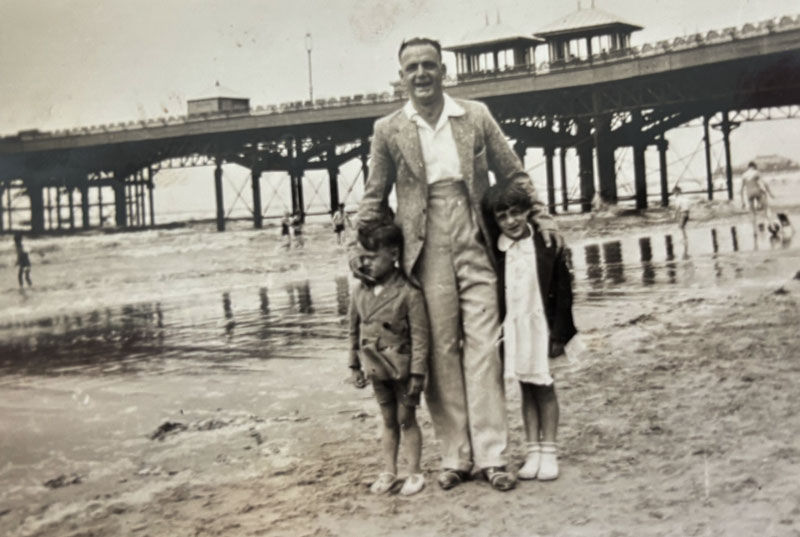
The four of us got split up, me and Gordon (the youngest) in one house. And Peggy and Walter, at the house facing. One morning, the bloke we were staying with, he hit Gordon. He were only four. I said, “We’re going home.” I went across and got the other two. We walked home – from Kippax! We walked in and my mum, she nearly had a heart attack. [We were home] the night the Woodpecker was bombed. We could hear the planes going and we could hear bombs dropping.
My eldest brother, Arthur, he was in France, fighting the Germans. And they were retreating. And he was Dunkirk. My mum never heard from him for weeks. She didn't know where he was. And then police came and told us that he'd got back to England, but he was in hospital.
Rita left school and went straight into a job.
I started work at Burton's. I was 14 on the 1st of January. And I started work on the 5th of January. They didn't give me much reprieve, did they? I think everybody in Leeds had somebody working at Burton's. Because they were doing all the uniforms, army and air force uniforms. They made thousands. I worked five and a half days for 90 pence. Do you know, I gave my mother my wage packet right up to being about 25, 26.
It was the infancy of computers. We had this electric thing with buttons on, we had to transfer all this information from this paperwork in the shop onto a card. In those days it was called Hollerith. Putting holes in all these cards, putting all the information on.
My hobby was ballroom dancing, I went at least twice a week. In those days, a ballroom was a ballroom. You could have a cup of tea, you could have a cup of coffee, but you couldn't buy liquor. I started going to the Astoria, and I loved that. There were two orchestras there, one at each side of the ballroom. They used to close the doors at nine o'clock. They wouldn't let anybody in after nine o'clock. Because they used to get kaylied, the lads, at the pub, get absolutely crazy. There’d be fights outside the Astoria because they couldn't get in. But I loved dancing.
I didn't get married till I was 30. I was engaged once. But he were in Merchant Navy. See, if I had any boyfriends, they were far away, so that they didn't interfere with me dancing! But one day, I was sat [at home], and Alfie, my eldest brother, says to me, “You look miserable. What's the matter?”
I said, “Oh, I don't know.”
He said, “Get your shoes on. Come down to the club with me. I'll buy you a drink.”
So, I went down to the club with him. Harehills Working Men’s Club. I met my two friends and I was playing dominoes with them. One of the committee men came up to me and said, “You can't play dominoes.”
I said, “Well, I'm beating these three.”
So, he said, “You know what I mean.”

I knew damn well what he meant but I took no notice. It's because the ladies weren't allowed to involve with the games. On the way out, [a young man] Arthur says to me, “it's my birthday next week. Will you come for a drink with me?” And I said yes.
The start of a beautiful friendship. He was lovely. Nicest man I ever met. It was February when we started going out. We got engaged in July. My dad was very ill then, he had cancer. Arthur said to me, “I think we should get engaged, because it’d make your dad a lot happier if he thought you were settling down a bit.” My dad did die in August. Then my mum were very ill - and Arthur said to me, “I think we should get married, give your mother something to think about.” So romantic! But I loved every inch of him I've never looked at a man since Arthur.
I had a honeymoon baby, didn't I? My first son was born in February. but I stayed in work till January. They said, “You're going to have that baby under your desk!” I said, “Well it’d give you something to do.” The Queen came to Burton’s. It was before my son was born. I was pregnant. I was stood on this table [to see her]. She wasn't a yard away from me. She was beautiful. She had the most gorgeous skin. But I looked up and saw my doctor facing me - Burton's had a doctor - “Get off that table!” Of course, next time I went to the surgery, he played Hell with me! You don't stand on tables when you're pregnant!”
Rita’s adventurous spirit was not restricted to marching her siblings back from Kippax to Leeds and standing on tables to see the Queen. Despite living in the same square mile for nine decades, Rita has travelled the world on frequent cruises and holidays. And, at 98, she continues to socialise as an enthusiastic member of Burmantofts Community Friends - though as admits, she does rather less ballroom dancing than she used to.
Thanks to Rita for sharing her memories and to Sheila at BCF for setting up the interview.


